
Data Structures and Performances: Lists
The goal of this post is to see how a contiguous-memory structure (arrays) compares to a pointer-based one (linked lists).
Recap
Let me start by recapping the difference between an array-based list (also called dynamic array) and a linked list. The first one is based on the array concept, i.e., store elements contiguously in memory, preserving a given order; the second one uses pointers to keep track of the order of the elements (see here for a quick comparison between linked list and dynamic array).
These different ways of implementing a list provide different performances: roughly speaking, array list requires less resources to read elements, and more resources to write elements (adding or removing), vice-versa for the linked list.
Read/Write performances
In this post we are going to validate this assertion by experimentally comparing the performances of these data structures. We are going to use the Java language, and the ArrayList and LinkedList class.
We start by comparing a simple read operation (get an element from the middle of a list), and a simple write operation (add an element to the end of the list). The results are as following:
(x: size of list, y: time in ms)
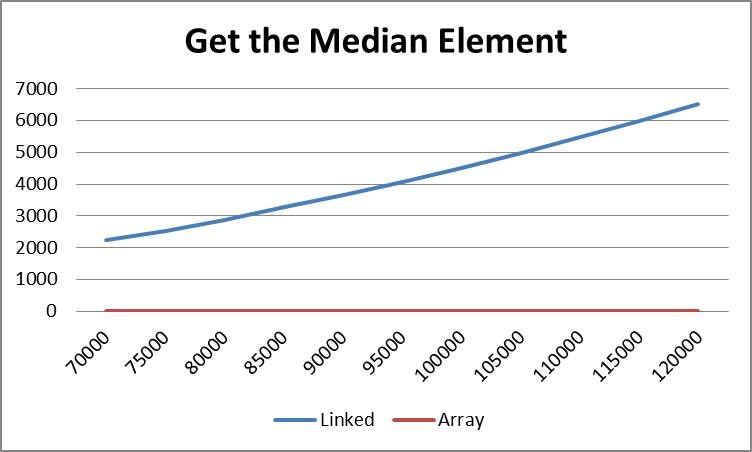
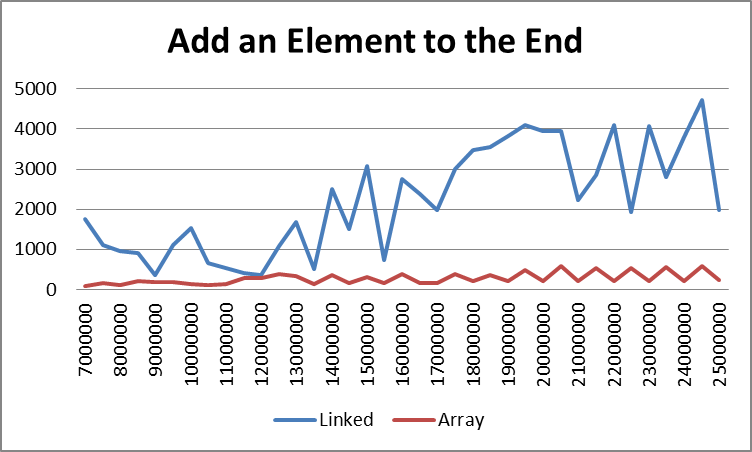
The “read” operation (get the median element) is much faster using an array list. In fact, getting an element from an array requires constant time. On the other hand, we would expect the linked list to be faster when adding elements. This is actually not true (as shown in the second graph): we can explain this considering that adding an element at the end of a list is a simple append operation which requires no shifting of the other elements even if the array list has to copy itself when making more spaces for more elements. It is also true that this happens few times. In particular, if the array doubles its capacity every time, it has to do it only log(n) times. In fact, we start from capacity 2, then 4, then 8…till n. The linked list has to deal with pointers, which is always an added “burden” (in terms of space and time)
In order to validate our assumption about linked list (i.e., linked list perform better when dealing with “write” operation), we can try to recreate a scenario where the array list performs worse due to its “less flexible” structure. We can do this by planning an experiment where we add elements in the middle of the list (which requires the array list to shift all the following elements to the right, while the linked list can simply change a pointer)
(x: size of list, y: time in ms)
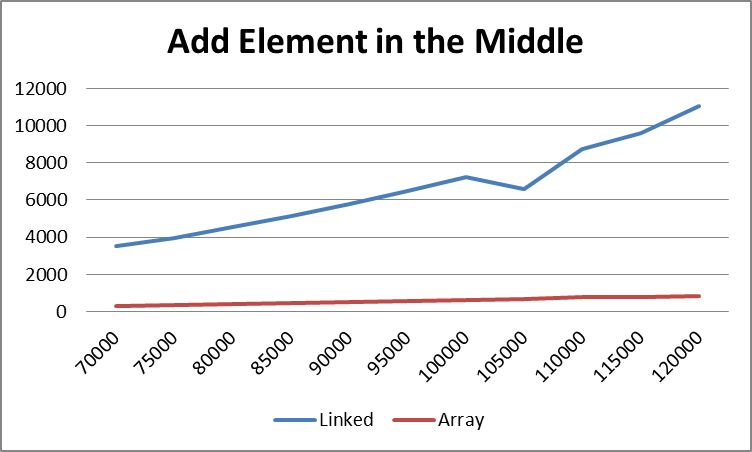
Again, the linked list performs worse. This is because before inserting an element, we have to find the median element, and as we’ve seen, this is not so easy for a linked structure. So, we could try removing this problem by adding the element to the beginning of the list; this way the shifting problem for the array list should remain, while the linked list should be able to access the element (the first one) in constant time
(x: size of list, y: time in ms)
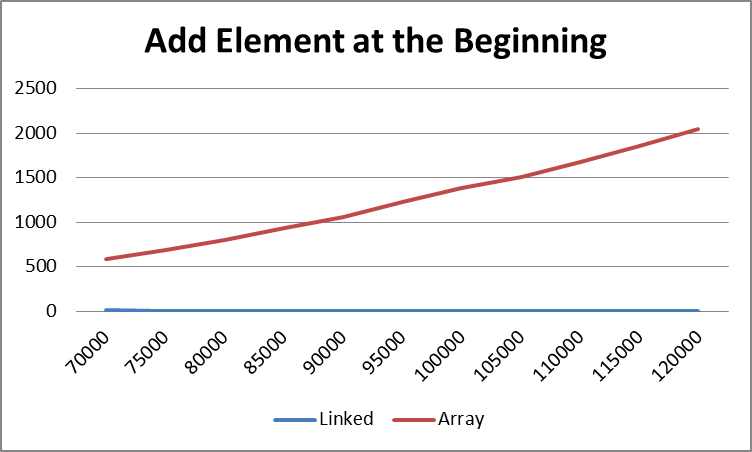
In fact, now the linked list performs much better.
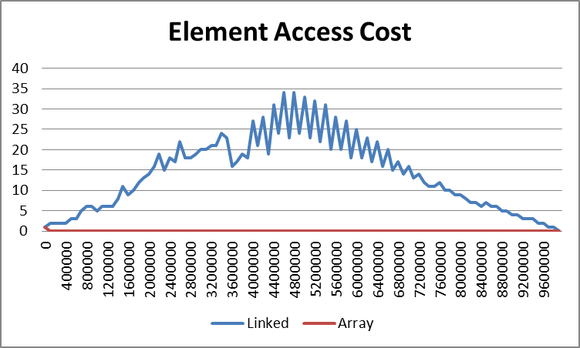
Summarizing: it is true that a linked list perform better when dealing with “write” operation, but it is also true that when accessing elements far from the list start, the element access operation comes with a high cost, because we must follow the chain of pointers. It is important to highlight that this is not true for the last elements, in fact the linked list implementation is (usually) “smart” enough to start the element research from the nearest endpoint; as we can see from the following graph, the worst cases for linked list element access are in the list middle
(x: element index; y: time in ms)
We could consider the linked list “not so useful” because they perform almost always worse than an array list. As a matter of fact, the only scenario where they perform better is when dealing with elements at the beginning and at the end of the list. Actually, this scenario is very common; in fact, when working with stack, we are only interested in getting elements from the first position, while with queue we are only interested in the first and last position. Because of this, and because of stack and queue importance, the linked lists are valuable data structure.
Comments